

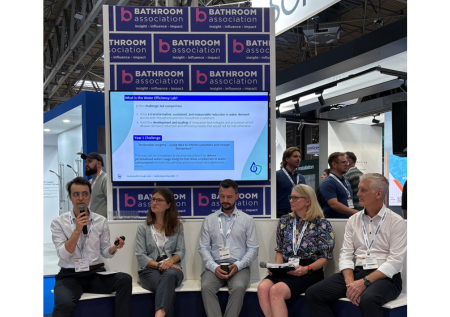
The Bathroom Association once again hosted the Bathroom Theatre at InstallerSHOW, providing a platform for industry discussion, technical insight and collaboration across the bathroom and wider built environment sectors.
On Tuesday, 23 June 2026, the opening day of the show, the Association welcomed Ofwat’s Water Efficiency Lab to the theatre for a session exploring how innovation can help address one of the UK’s most pressing long-term challenges: reducing demand for water.
England and Wales face an urgent water shortfall, with England projected to face a deficit of nearly five billion litres per day by 2055. To help tackle this, Ofwat has established a £100 million Water Efficiency Fund, designed to drive a transformative, sustained and measurable reduction in water demand across England and Wales.
As part of this wider fund, £25 million has been allocated to the Water Efficiency Lab, a challenge-led competition created to attract innovative solutions to specific water efficiency challenges. The programme is designed to unlock progress in water-efficient technology, processes and approaches, helping people and businesses take greater control of their water use and make saving water simpler, more practical and more effective.
The first Water Efficiency Lab competition, known as WEL 1, focused on solutions that provide tailored, data-led and actionable insights to customers. These innovations are intended to help households and businesses understand where water is being used, where it may be wasted, and what practical steps can be taken to reduce consumption.
The session at InstallerSHOW was chaired by Jude Noro, Senior Associate in Ofwat’s Water Efficiency and Innovation Team, and moderated by Hannah Dummett, Programme Manager at Challenge Works.
Jude introduced the Water Efficiency Lab to the audience, outlining its purpose, the scale of the water-demand challenge, and the role innovation can play in helping to close the projected supply gap. The session also showcased projects from the first WEL competition and previewed the theme and opportunities for the second competition.
Attendees heard directly from three of the winning projects:
Dan Simmons, Managing Director at Quensus, presented The WIN Initiative, which has been awarded £495,000. The project will install more than 1,000 sensors across 30 commercial buildings to help tackle the 10 to 30 per cent of water lost in commercial settings through leaks and continuous flow. The project will also explore whether linking water efficiency to insurance premiums could help turn water saving from a voluntary commitment into a financially motivated business priority. Insurer Aviva is involved in exploring how a new Water Management Plan standard could unlock benefits for building owners.
Neil Pendle, Non-executive Director at Waterscan, presented Workplace Water Wins, which has been awarded £677,000. Led by Waterscan, in partnership with Anglian Water, Greene King, John Lewis Partnership, Morrisons, Sainsbury’s, the University of Surrey, and others, the project will install sub-metering across pubs, supermarkets, and hospitality and leisure sites. By using multiple meters across a premises, businesses can see exactly where water is being used, whether in kitchens, bathrooms or outdoor spaces. This more granular insight can help businesses act quickly, reduce waste, cut costs and operate more sustainably without disrupting day-to-day operations.
Orlaith Senior, Head of Client Services and Delivery at Advizzo, presented MyWaterGPT, which has been awarded £860,000. The project will build the first sector-specific large language model in the UK water industry. The conversational AI tool will allow customers to ask questions about their water use in plain language and receive personalised, actionable answers. Drawing on smart meter data where available, the model will be able to spot leaks, explain unusual usage and provide household-specific insights without requiring any personally identifiable information. The project is led by Advizzo, part of Calisen Group, in partnership with South West Water, Spring Innovation, Waterwise and others.
In the first round of the Water Efficiency Lab, seven pioneering projects have been awarded a share of £5 million to develop innovations that provide customers with data-led insights to save water.
Other winning projects include the 50L Home England Pilot, led by Northumbrian Water in partnership with Electrolux, Barratt Redrow, IKEA, Groundwork, P&G, Waterwise, the University of Surrey, the World Business Council for Sustainable Development, the World Economic Forum and others. The pilot brings together innovative appliances, fixtures and everyday products, including dishwashers that remove the need to pre-rinse, washing machines that clean effectively in cold water and high-pressure, low-flow showers. These will be trialled in existing and new UK homes alongside behavioural science and data-driven insights, with the aim of demonstrating that household water demand can be reduced by 30 to 40 per cent while improving quality of life and cutting bills.
Water Warriors, led by the Water Research Centre, has been awarded £365,000 to bring water science into primary classrooms. Designed around the Key Stage 2 curriculum, the programme embeds water across science, maths, English and art, helping pupils understand how water moves through their homes, communities and environment. The project aims to empower children with knowledge about water use and support them in sharing that learning with their families.
Helping Homes Save Water Outdoors, led by the Royal Horticultural Society in partnership with Affinity Water, Severn Trent, Thames Water and others, has been awarded £1.1 million. The project will help water companies build a much clearer picture of how water is used in gardens and outdoor spaces, supporting more targeted and effective approaches to reducing outdoor water demand.
Together, the winning projects demonstrate the breadth of innovation needed to support water efficiency, from household appliances and smart data to workplace monitoring, outdoor water use, education and artificial intelligence.
The Water Efficiency Lab is delivered by innovation prize experts Challenge Works, part of Nesta, in partnership with Arup and Isle Utilities, and is funded by Ofwat’s Water Efficiency Fund.
The second Water Efficiency Lab competition, WEL 2, will focus on innovations to reduce customer-side leaks in homes and businesses, and will open for entries on 3 August 2026.
To find out more about the winners of the first Water Efficiency Lab and future competitions, visit waterinnovation.challenges.org.
Pictured left to right: Jude Noro, Senior Associate in Ofwat’s Water Efficiency and Innovation Team, Hannah Dummett, Programme Manager at Challenge Works, Dan Simmons, Managing Director at Quensus, Orlaith Senior, Head of Client Services and Delivery at Advizzo, and Neil Pendle, Non-executive Director at Waterscan.