

A major new report from Public First has delivered a stark message for business, policymakers and the wider water efficiency sector: water scarcity is no longer a distant environmental issue but an increasingly immediate economic one. In Risking Growth: The Impact of Water Deficits on Business, Public First argues that the assumptions underpinning current planning for non-household water use are becoming harder to sustain, and that failure to act could have serious consequences for jobs, investment and development across England.
The report focuses on the non-household market, which covers business, public sector and other commercial water users. While household consumption still accounts for around two-thirds of water use in England, the remaining share used by non-household customers plays an outsized role in economic activity. Public First notes that the Environment Act framework expects non-household water use to fall by 9% by 2038 compared with a 2020 baseline, with those reductions already reflected in water companies’ 2024 Water Resource Management Plans.
The problem, however, is that the trend is moving in the wrong direction. Public First’s analysis of long-term data from 2005 to 2023 found that although non-household water use fell over much of that period, the pace of improvement has slowed sharply in recent years. The report says many of the earlier “easy wins”, including metering, water-efficient appliances and more efficient industrial processes, have already been captured. Its modelling suggests that non-household water use may in fact have started rising again from 2024, making the 9% reduction target increasingly unlikely to be met.
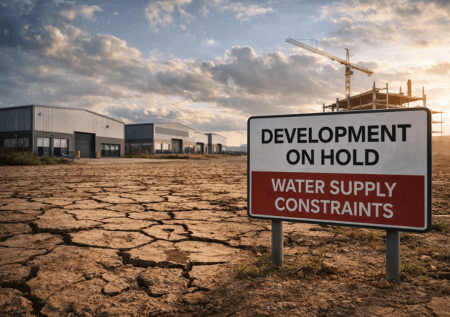
That matters because water is becoming a constraint on development. The report highlights examples of business activity already being affected by supply pressures, including the moratorium on new non-domestic supplies in the Hartismere Water Resource Zone and concerns raised over major developments in North Lincolnshire and Cambridge. Public First’s conclusion is blunt: if water demand does not align with planning assumptions, more parts of the country could see business expansion delayed or blocked under the current regulatory framework.
The economic risks are substantial. Public First modelled a scenario in which non-household water use stops declining and instead remains flat from 2025 onwards. In that case, England would face a water deficit of 13.7 megalitres a day by 2035 across 36 Water Resource Zones. The report estimates that this could block up to £10.1 billion in economic growth by 2035, equivalent to a 0.46% loss in English GVA, affecting 95 local authorities. Even if half of the planned reduction were achieved, the report still projects a 6.7 Ml/d deficit and up to £5.1 billion in lost growth.
The research also points to the commercial impact of short-term disruption. Public First estimates that if a severe drought forced all business water use to be curtailed for just two days, UK businesses would lose on average 23.2% of their revenue and 26.9% of their economic activity over that period. That finding underlines why long-term resilience planning matters just as much as day-to-day efficiency.
For the Bathroom Association and its members, the report lands at an important moment. It reinforces the case that water efficiency is not simply a sustainability issue or a matter of consumer choice; it is increasingly tied to economic resilience, infrastructure planning and business confidence. The finding that earlier progress was partly driven by the roll-out of water-efficient appliances should also serve as a reminder that product innovation has already made a measurable contribution and will need to do so again.
At the same time, the polling in the report suggests there is more to do. Public First found that 61% of businesses believe water shortages pose a risk to their operations, 62% are interested in reducing water intensity, and around one in five of those interested do not know how to do it. On average, decision-makers believe their organisations could cut water use by 15% without harming productivity, but the report says this potential is unlikely to be realised without better guidance, incentives and support.
The message is clear. If England is serious about growth, it also needs to be serious about water efficiency. Public First’s report makes the case that smarter water use, better planning and stronger support for efficiency are now essential not only for environmental resilience but also for economic growth.